

How to Take Graded Cards to a Card Show Without Damaging Them
Most damage to a graded card does not happen at a card show. It happens on the way there, in a bag, with eight other slabs sliding around loose.
A slab is tough against the things people worry about — fingers, dust, a spilled drink — and surprisingly fragile against the thing they don’t: another slab. Two hard plastic cases rubbing together for an hour on a train produce exactly the scuffs across the window that make a card harder to sell, even though the grade on the label has not changed.
Here is how to move them properly.
What actually goes wrong in transit
Four things, in rough order of how often we hear about them:
- Scuffed windows. Slab-on-slab contact. The case is acrylic, the corners of the next case are hard, and vibration does the rest.
- Chipped corners. A drop, or a bag going down harder than you meant on a table edge. Corners take the impact first.
- Cracked cases. Weight on top. A slab at the bottom of a rucksack under a laptop is a slab under pressure.
- Peeled or scratched labels. Less common, but a damaged label is a resubmission.
None of it is dramatic. That is the problem — you only notice at home, in good light, when it is too late.
Give every slab its own barrier
The single highest-value habit: never let two slabs touch each other directly.
The cheap version is a sleeve or a soft cloth between each one. The better version is a bumper guard — a frame that clips around the slab and puts a layer of protection on the corners and edges, which are the parts that do the damage and take the damage. Guards also stop slabs sliding against each other, because the surfaces meeting are no longer slick plastic.
If you are only carrying one or two cards and they are the good ones, an acrylic slab case is the belt-and-braces option — a rigid outer shell that takes the knock instead of the slab.
Choosing what to carry them in
Rucksack
Fine if you pack it properly, which most people don’t. The failure mode is weight: slabs end up under everything else. If you use one, keep the cards in a rigid container inside it rather than loose in a pocket.
Toolbox or hard case
Genuinely protective, and popular with dealers for a reason. The downsides are obvious once you are walking a show floor for six hours — it is heavy, it needs a hand, and you have to put it down to look at anything.
Crossbody bag or sling
The sweet spot for most collectors. It stays on your body, which solves the security problem as well as the damage one, and it leaves both hands free to actually look at cards. The compromise is capacity: you are carrying a handful of slabs, not a hundred.
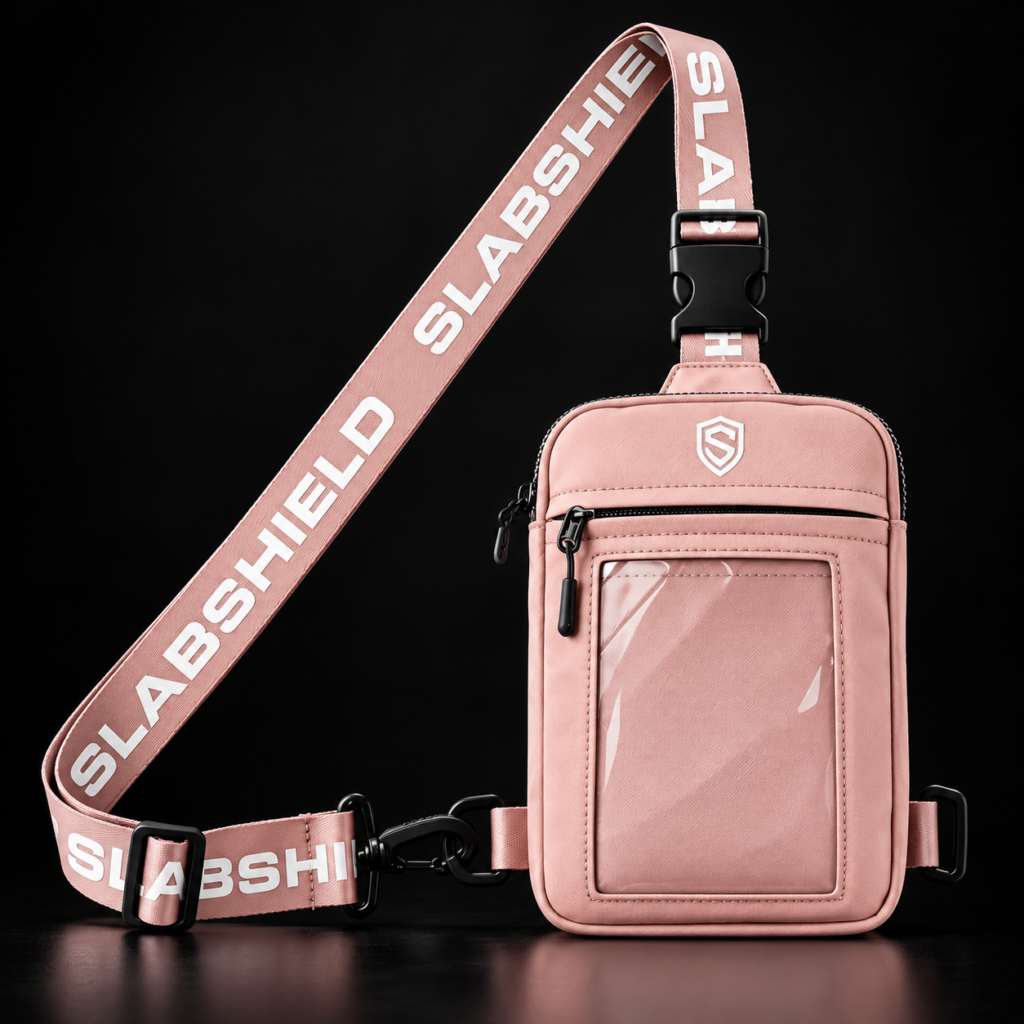
Our crossbody slab bag was built around this exact trip — a zipped main compartment for multiple graded cards and a clear front display pocket so your best card faces outward while you walk around. It is lightweight nylon with an adjustable branded strap, in beige and blush pink, £27.99.
Packing it
- Slabs on edge, not flat. Stacked flat, the bottom one carries everything. On edge, like records, the load spreads and nothing sits under pressure.
- Snug, not crammed. You want no room to slide and no force to close. If the zip is straining, take one out.
- Heaviest against your back. Standard rucksack logic, and it applies to slings too — weight close to your body moves less.
- Nothing hard loose in the same compartment. Keys, a power bank and a slab in one pocket is how windows get scratched.
- Grails separately. If one card is worth more than the rest put together, it should not be in the same pocket as the rest.
At the show
Keep the bag on you. Not on the back of a chair, not on the floor by your feet, not on a table while you look at the next one along. Show floors are busy and distracted, and a bag that leaves your body is a bag that might not come back. A crossbody strap is genuinely a security feature, not just a comfort one.
When someone wants to see a card, hand them the slab rather than letting them take it from the bag — you control how it comes out. Hold slabs by the edges, the way everyone handles them, and put them down on the table rather than passing hand to hand over a hard surface.
If you are handed someone else’s slab, do the same. Two seconds of care buys a lot of goodwill in a room where everyone is nervous about their cards.
Getting home
Repack properly rather than shoving new purchases in on top. A card you have just bought is the one you know least about — you do not know how it has been stored, whether the case already has a hairline crack, or how it will behave next to your existing cards. Give it a sleeve or a guard before it joins the others.
And check everything in good light when you get in, while a seller’s memory of the transaction is still fresh.
If you are posting instead of carrying
Different problem, different answer. Packing a slab for Royal Mail has its own rules about which service actually covers a graded card and how to pack so the case is not the thing absorbing the impact — we wrote that up separately in how to post a graded card safely in the UK.
Know what is in the bag before you leave
The other half of a good show is knowing what you are carrying and what you are hunting. Catalogue your collection free in the SlabShield Vault and you can pull up your wants list on your phone at a table instead of trying to remember which number you still need.
Every set is in there, so you can check a set off card by card: Pokémon sets, One Piece sets, Lorcana sets, Magic sets, Gundam sets and Riftbound sets. Mark the cards you will trade, and the Vault tells you when another collector has something on your list.
The short version
- Never let two slabs touch — guard, sleeve or case between every one.
- Carry them on edge, snug, weight close to your body.
- Crossbody beats rucksack for anything under about a dozen cards.
- The bag does not leave your body at the show.
- Check everything at home, in good light, the same day.